
Before We Call Out AI Users, Let’s Look at the Full Picture
Responsible AI use isn't a yes-or-no question about the environment; it's context, intention and discernment.
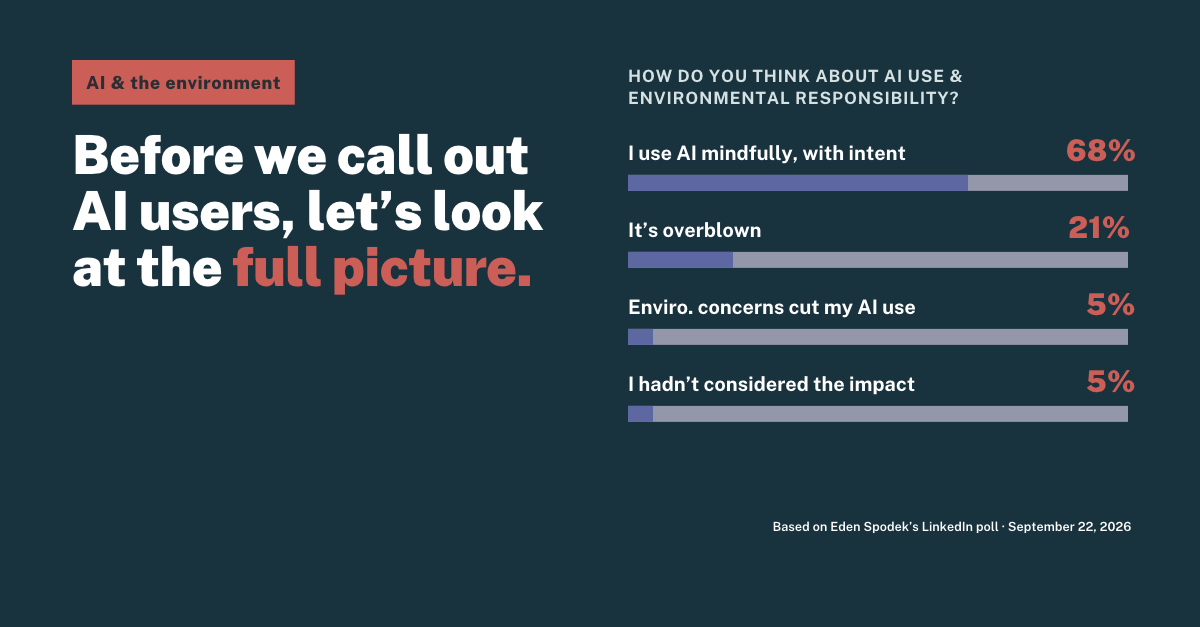
Last week, I posted a LinkedIn poll: How do you think about AI use and environmental responsibility?
It was a small poll, but the conversation around it was telling: 19 votes generated 24 comments and counting.
Sixty-eight percent of respondents said they use AI mindfully, with context guiding their decisions. Another 21% said the environmental concern is overblown relative to other factors. Only 5% said environmental concerns have actually changed their AI use.
What interested me most wasn’t the numbers themselves. It was the nuance in the conversation.
Keep the Concern Real and the Framing Fair
Environmental concerns about AI and data centres are legitimate. At scale, their energy and water demands demand our attention.
When the conversation shifts from systemic accountability to individual shaming, particularly of people actively learning and working with these tools, something important gets lost.
Even apparently straightforward comparisons aren’t as simple as they appear. Estimates of the energy required to generate an AI image vary considerably depending on the model, hardware and methodology. The same is true of water use.
I recently met with Pam Boiros, co-founder of Women Applying AI. She shared a comparison that stayed with me. Depending on the estimates and accounting methods you use, the water footprint of manufacturing a single pair of jeans can dwarf that of individual AI prompts. (Look it up; the stats are astounding. And that doesn’t include washing them.)
Her broader point was that we need to look at our choices in context rather than isolating one technology from everything else we consume and use.
I say that as someone who has been intentionally moving away from fast fashion since the early days of COVID. Not to score points, but because I think it’s important to look at our own choices with the same scrutiny we apply to others. (Coincidentally, we compared notes about our common relatively recent interest in thrifting.)
Look at What Else People Are Concerned About
Randy Matheson messaged me about their findings from a workforce assessment of 2,500 knowledge workers in Canada and the U.S. who were asked, in an open-ended format, about their concerns with using AI. (Credit: twenty44 Ai/44 Index (2026))
Of those who responded to the Ai/44 index, 10 percent cited Environmental impact as a genuine concern. It ranked sixth among respondents.
The data also shows that people are wrestling with a much broader spectrum of issues around AI adoption, with accuracy, critical thinking, privacy and job displacement mentioned more frequently.
Focusing intensely on the environmental impact of AI while rarely applying the same scrutiny to other technologies and consumption choices can make the conversation feel selective. I think we’re better served by looking at the full picture.
Hold Individual, Aggregate and Corporate Responsibility Together
A few comments on my poll really stood out.
Micah Adler put it plainly:
“...I do not think this is an either/or choice where we must stop using AI to protect the environment. For those of us who are not in the business of building data centres, the reality is what Eden describes: we are trying to survive, and to make sure our children can thrive in an era where AI will likely be part of almost every aspect of our lives.”
He also made a point worth amplifying: the companies developing AI at breakneck speed need to be accountable for their impact on communities, including decisions about where data centres are built and how they’re powered.
Yvette A. Elliott, MBA, Chartered Marketer, added another important layer:
“The flight comparison is the part that actually lands... Where I’d push a little further: the real environmental question isn’t the per-image cost, it’s aggregate scale, millions of people generating dozens of images a day adds up differently than one person’s occasional use.”
Exactly.
Individual actions matter. Aggregate impact matters. And corporate responsibility matters.
All of these can be true at once.
Learn When to Use AI, Not Just How
Dorothy Vernon-Brown brought it back to a word she keeps returning to: intention.
“For me, responsible AI is also about discernment — where does it genuinely add value and where are we better off without it? Perhaps one of the most important AI skills we’re developing is knowing when NOT to use it.”
That may be the most important contribution to this conversation.
We’re not just learning how to use these tools. We’re learning when to use them.
Ask Why People Are Experimenting with AI
This is the part of the conversation I think we’re missing.
Why are people experimenting with AI in the first place?
Some are learning. They’re trying things, making mistakes and figuring out what these tools can and can’t do. Hands-on exploration is one way professionals stay informed in a field that’s moving quickly.
Some are making technology more accessible. Something as simple as sharing an AI image trend — easy to try, low barrier, even a little playful — can help someone who feels intimidated by AI take a first step toward understanding it.
That has value.
And some are trying to build sustainable businesses and careers.
AI is increasingly integrated into the tools, platforms and workflows many of us rely on every day. Choosing not to engage isn’t necessarily a neutral decision. It can carry professional risk, particularly for small business owners and independents who don’t have teams of people experimenting with these technologies on their behalf.
As Pam put it:
“You cannot be part of the conversation in your community, in your school, in your [field], unless you are educated about these topics. If you’re just parroting back some soundbite that somebody said, you need to be educated.”
I think that applies to the environmental debate, too.
Practice Responsible AI Use: Context, Intention and Discernment
For those of us actively engaging with AI professionally, creatively or educationally, I don’t think the most useful question is simply: Should we use AI?
It’s: When does using it make sense, and how do we use it responsibly?
That means staying informed about the environmental and ethical dimensions of the tools we use.
Being intentional about when AI adds genuine value versus when we’re using it simply because we can.
Continuing to question its impact.
And pushing the companies building these systems for greater transparency, accountability and more sustainable infrastructure.
It also means giving one another a little more credit.
Many of the people I see exploring AI aren’t doing so carelessly. They’re trying to understand a technology that is genuinely changing how we work, learn and communicate.
The technology is here. It’s moving quickly.
We can acknowledge its environmental impact and learn how to use it thoughtfully. We can question the industry and help shape how these tools are adopted.
Those aren’t contradictions.
To me, that’s what responsible adoption looks like: context, intention and discernment.
What does responsible AI adoption look like in your work? I’d genuinely like to hear.
Ready to put structure around how your business uses AI? Book a discovery call to talk through where AI is already at work in your organization, where human judgment belongs, and who should be deciding what happens next.
Book a discovery call