
The Turkey Problem: Why a Clean AI Record Means Nothing Without Controls
A long record of good AI days says little about the next one, so build controls that make being wrong cheap.
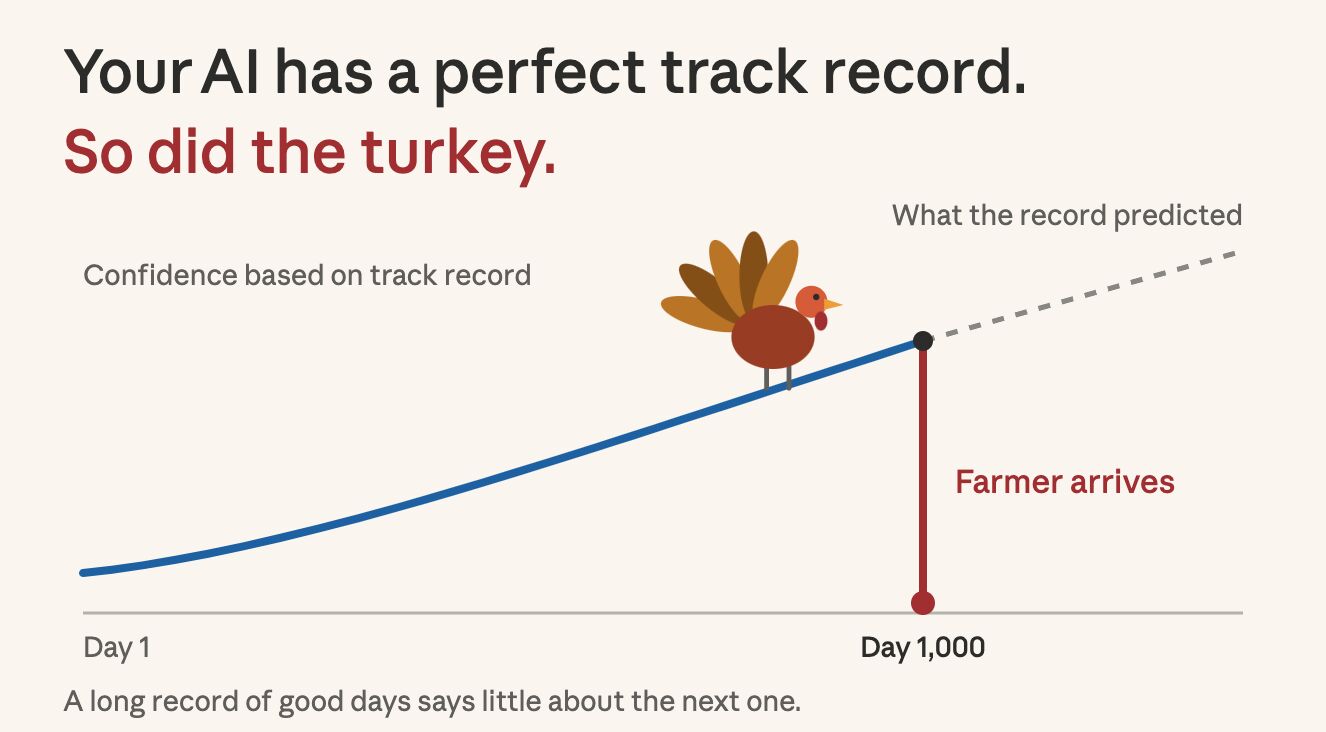
Your AI has a perfect track record. So did the turkey.
A turkey hatches on a farm, and on day one a human shows up with food. Day two, same. Day 100, still the same. By day 500, the turkey has what looks like a law of nature: humans bring food.
After 1,000 days it is more confident than ever that humans bring food. On the Wednesday before Thanksgiving its confidence peaks, and that afternoon the farmer arrives with a different plan.
Nassim Taleb uses this story to show that a long record of good days tells you very little about what comes next. It applies directly to how companies are adopting AI.
Don't Mistake a Clean Record for a Safe System
Today's AI systems learn from past data, and nobody, including the people who build them, can say with confidence how one will behave in a situation unlike anything it was trained on. A model can handle thousands of routine requests correctly and then fail on the one that matters, often with the same fluent confidence as all the correct answers.
Aim for Antifragile, Not Just Resilient
Since we can't predict how AI will behave in every case, the better goal is to be antifragile, a term Taleb coined for systems that get stronger from shocks. A fragile setup breaks when something unexpected happens. A resilient one survives it. An antifragile one learns from it.
Make Surprises Small, Visible, and Instructive
In practice, that means arranging things so that surprises are small, visible, and instructive:
- Start with low-stakes uses where a bad output costs little, and expand only as you learn.
- Small failures are cheap tuition.
- Keep a human sign-off on anything irreversible: payments, legal commitments, customer promises, deletions.
- Cap the damage with spending limits, scoped permissions, and an off switch that works.
- Review near misses. Every error caught early should change a process, a prompt, or a rule.
- Try to break the system on purpose before your customers do.
- Treat a clean record as a reason to keep your controls in place. It says little about what the system will do in a situation it has never seen.
We can't know in advance how these systems will behave, so the practical goal is to make being wrong cheap and to learn something each time it happens.
Ready to put structure around how your business uses AI? Book a discovery call to talk through where AI is already at work in your organization, where human judgment belongs, and who should be deciding what happens next.
Book a discovery call