
Why Prompting AI Is Like Restoring an Antique Table
The quality of what AI gives back depends on what you bring to it, and a good output is never the finished product.
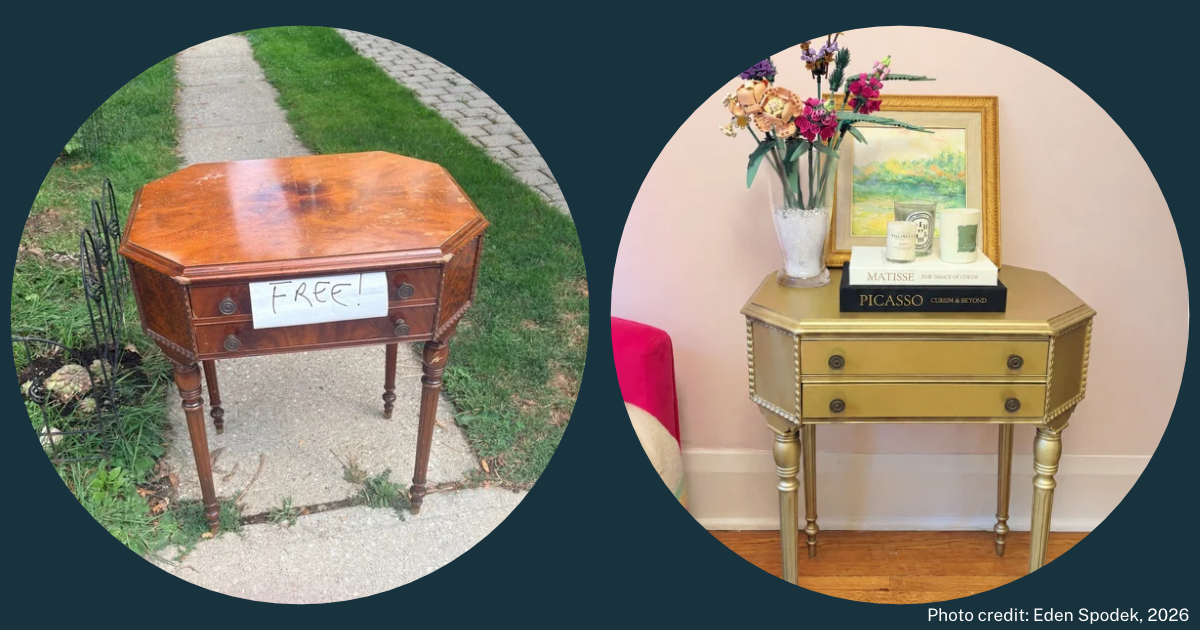
I found an antique table at the curb a few weeks ago with a big “FREE” sign taped to the front.
Timing was perfect. Coincidentally, I'd seen an interior designer paint a thrifted table a few days earlier, and it inspired me. Naturally, I brought it home.
The table had good bones. I could see its potential and had a pretty clear idea of what I wanted it to become. What I didn’t know was how to get it there other than using spray paint. So, I turned to one of my virtual friends and sometimes collaborator, ChatGPT.
I shared a photo of the table with the “FREE” sign, explained what I was starting with and what I hoped to achieve. We explored a few options before I settled on a specific shade of gold.
Then it gave me a detailed plan with visuals: what to buy, how to prep the table, what order to do everything in and some tips to avoid common mistakes.
Bring Context, Because AI Reflects What You Give It
Somewhere between sanding, priming and spray painting, I realized the project was a pretty good analogy for working with AI. The quality of what you get back depends a lot on what you bring to it.
In this case, I started with a table with good bones. I had a clear vision and provided a photo, context and enough information for ChatGPT to understand what I was trying to accomplish.
Like me, AI had something solid to work with.
Treat a Good Output as a Starting Point
But a good output wasn’t the finished product.
I still checked recommendations, talked to the very helpful people at my local paint store, bought the supplies and did the actual work.
Use AI to Troubleshoot When Things Go Wrong
And there were glitches. Messy wood filler. Spray-paint drips. A couple of spots that needed fixing. Each time, I could go back, explain what happened and work through a solution.
That’s where the collaboration came in.
AI helped me fill some knowledge gaps and troubleshoot along the way.
Supply the Vision, the Judgment and the Elbow Grease
But I supplied the foundation, the vision, the judgment and, quite literally in this case, the elbow grease.
There are still a few finishing touches to go, most noticeably adding the door pull back.
That seems fitting too.
What are you bringing to your work with AI that helps it give you something expected, if not better, in return?
Ready to put structure around how your business uses AI? Book a discovery call to talk through where AI is already at work in your organization, where human judgment belongs, and who should be deciding what happens next.
Book a discovery call